
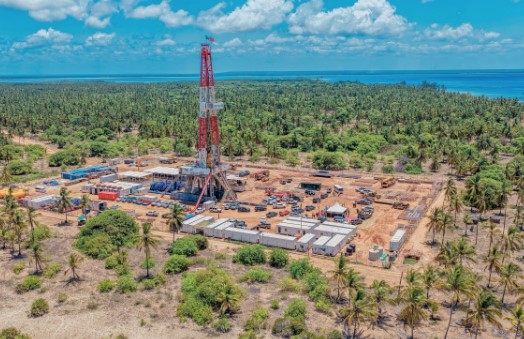
French independent Maurel & Prom (M&P) has confirmed a natural gas discovery at the Mnazi Bay license in southern Tanzania, with early estimates pointing to roughly 223 billion cubic feet (bcf) of gas. The find adds fresh volumes to one of East Africa's longest-running gas operations, and could be flowing into the national grid within weeks.
The discovery came from the Kasa-1X exploration well, drilled jointly with the state-owned Tanzania Petroleum Development Corporation (TPDC). M&P disclosed the result in its activity report for the first nine months of 2026, describing a gas reservoir with encouraging characteristics.
What sets Kasa-1X apart is how it reached its target. Rather than mobilizing an offshore rig, the partners drilled from land toward a reservoir lying about 4.5 kilometers offshore, beneath roughly 400 meters of water. That approach lets the field tap offshore gas while relying on existing onshore infrastructure.
Kasa-1X: from spud to sidetrack
Drilling on Kasa-1X began in June 2026. After the initial well confirmed the presence of gas, the partners drilled a sidetrack, a secondary borehole branching off the original. The sidetrack intersected 588 meters of reservoir, a substantial interval that underpins confidence in the find.
Gross gas volumes are currently put at about 200 bcf. M&P holds a 60% working interest in the license, so its net share comes to roughly 120 bcf. These are preliminary figures, and they may be refined as production data accumulates.
The timeline to first gas is unusually short. M&P envisages production starting as early as November 2026, only about five months after drilling began. The company estimates the discovery's gross production potential at 50 million cubic feet per day (mmcfd).
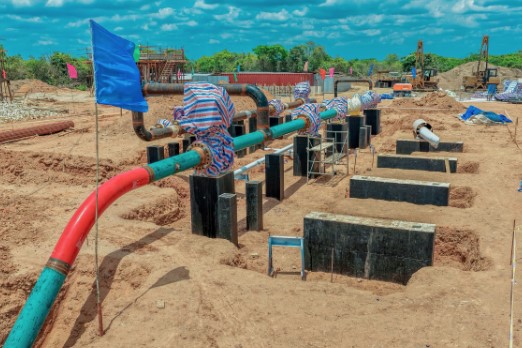
That speed reflects the advantages of a brownfield setting. Mnazi Bay already has wells, pipelines and a processing plant in place, so a new discovery can be tied in rather than built from scratch.
Development wells lift field output
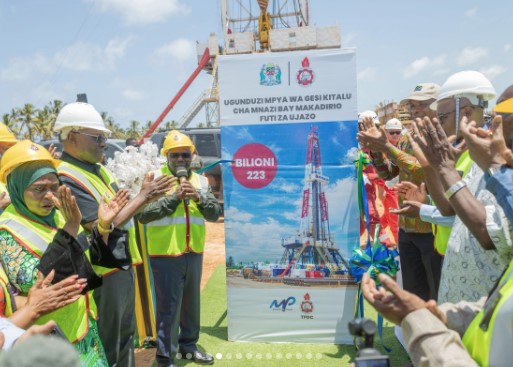
Kasa-1X was one part of a broader three-well campaign. Tanzania's Ministry of Energy announced on October 18 that drilling had been completed on all three wells in the Mnazi Bay Block in Mtwara Region: two development wells and one exploration well.
The two development wells, MB-5 and MS-2, were drilled in the first half of 2026 and have since been brought on stream. Together they have pushed current field production to about 130 mmcfd, or 78 mmcfd net to M&P. They have also raised the combined production potential of existing wells to nearly 200 mmcfd.
|
Measure |
Gross (100%) |
M&P net (60%) |
|
Kasa-1X estimated gas volumes |
~200 bcf |
~120 bcf |
|
Kasa-1X production potential |
50 mmcfd |
30 mmcfd |
|
Current Mnazi Bay production |
~130 mmcfd |
~78 mmcfd |
|
Potential of existing wells |
~200 mmcfd |
~120 mmcfd |
|
Tested processing capacity |
150 mmcfd |
— |
One figure deserves attention: the field's gas processing facilities have been tested at 150 mmcfd. With well potential approaching 200 mmcfd before Kasa-1X is added, surface capacity rather than the subsurface may become the limit on output. Demand from Tanzania's power sector will also shape how much gas is actually produced.
The results are already visible in M&P's numbers. Its working interest production from Mnazi Bay averaged 67 mmcfd over the first nine months of 2026, up 12% from the same period in 2025.
What it means for Tanzania
For the government, the find is a welcome addition to the national resource base. The Ministry of Energy expects it to increase Tanzania's natural gas reserves, currently put at 57.54 trillion cubic feet. Officials plan to formally inaugurate the wells and announce the discovered volumes.
At around 200 bcf, Kasa-1X is modest next to the country's large deepwater discoveries, whose development has moved slowly. Its value lies in speed and proximity. Gas from Mnazi Bay feeds domestic power generation, and near-field volumes that can flow within months help keep supply steady for homes and industry.
The discovery also shows the remaining potential around mature fields. Drilling from shore to reach offshore targets could open nearby prospects at lower cost than a full offshore campaign. Success here may encourage similar approaches elsewhere along the coast.
The road ahead
Tanzania is widening its exploration push beyond Mnazi Bay. Further oil and gas activity is planned in North Mnazi Bay, West Songo Songo, Lindi–Mtwara, Eyasi–Wembere and Ntorya. The spread runs from the southern coast to inland basins in the north.
For M&P, the near-term test is execution. Bringing Kasa-1X online on schedule in November, and matching processing capacity to rising well potential, will decide how much of this discovery turns into revenue. If the partners deliver, Mnazi Bay's output and Tanzania's gas supply should both enter 2027 on a stronger footing.
Africa Team