
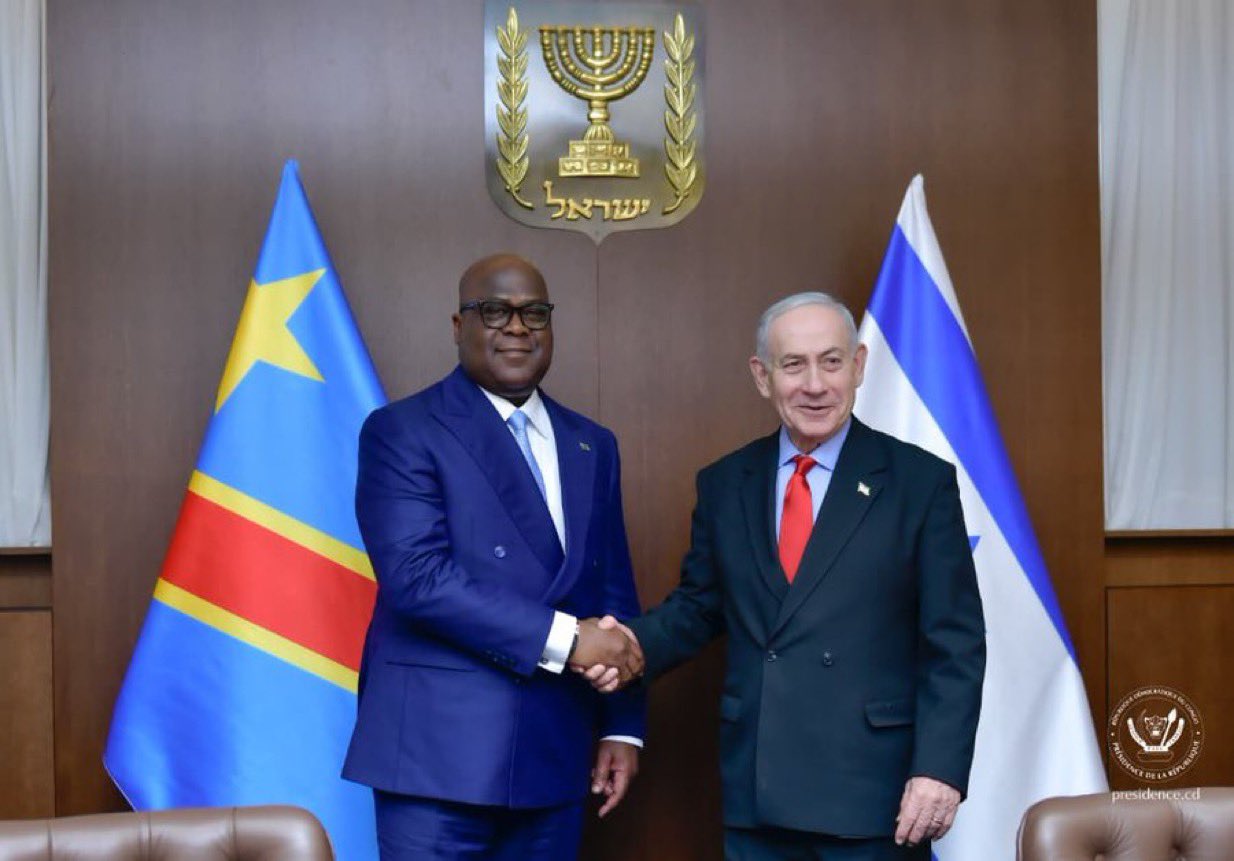
JERUSALEM, September 1, 2026 — Israeli Prime Minister Benjamin Netanyahu and Democratic Republic of Congo President Félix Tshisekedi held high-level talks in Jerusalem on Tuesday, signalling a further strengthening of relations between Israel and one of Africa’s largest and most strategically important countries.
The meeting focused on expanding bilateral cooperation across security, defence, agriculture, infrastructure, energy and advanced technology, according to the Presidency of the Democratic Republic of Congo. Netanyahu described the relationship between the two countries as a “great friendship” and said the visit would help deepen it further.
Tshisekedi arrived in Israel on Monday, August 31, for a working visit focused on strengthening bilateral cooperation. His programme includes meetings with Netanyahu and Israeli President Isaac Herzog, reflecting the importance both governments are placing on their relationship.
The talks come at a significant moment for the DRC, which is seeking to expand international partnerships as it confronts major security, infrastructure and economic challenges while attempting to unlock the country's considerable natural and strategic potential.
Security and Defence at the Centre of Cooperation
Security and defence were among the principal areas discussed by Netanyahu and Tshisekedi.
For Kinshasa, cooperation with Israel comes as the DRC continues to face persistent security challenges in its eastern provinces. The country has been working to strengthen its national security institutions while pursuing diplomatic initiatives aimed at achieving greater stability in the region.
The two governments' growing engagement also reflects Israel's longstanding interest in developing security partnerships with African states. Israel has capabilities and expertise in areas including security technology, intelligence, border management, cybersecurity and other forms of defence cooperation.
The DRC Presidency said the discussions covered security and defence alongside agriculture, infrastructure, energy and high technology, pointing to an increasingly broad relationship that extends beyond traditional diplomatic engagement.
The discussions also take place against the backdrop of wider regional efforts to address instability in the Great Lakes region. During meetings involving Congolese and Israeli officials, Israel's Foreign Minister Gideon Sa'ar said discussions included the implementation of the peace agreement between the DRC and Rwanda.
From Agriculture to Advanced Technology
Economic and technological cooperation represents another important dimension of the emerging partnership.
Israel has developed internationally recognised expertise in agricultural technology, water management, irrigation, energy innovation, cybersecurity and technology-driven infrastructure. For the DRC, these areas are particularly relevant as the country seeks to increase agricultural productivity, expand access to infrastructure and energy, and develop technologies capable of supporting economic growth.
The DRC's vast territory and large population present both a challenge and an opportunity. Improving agricultural production, energy access, transport infrastructure and digital connectivity will be critical to transforming the country's economic potential into broad-based development.
Israeli expertise could therefore complement the DRC's investment priorities, particularly where technology can be deployed to address infrastructure and productivity constraints.
The two sides had already taken steps in this direction before Tshisekedi's latest visit. On July 27, DRC Foreign Minister Thérèse Kayikwamba Wagner and her Israeli counterpart signed memorandums of understanding covering areas including diplomatic training, agriculture, healthcare and technology.
Tshisekedi's visit provides an opportunity to move these agreements beyond diplomatic commitments and toward practical projects, investment and commercial partnerships.
The Lobito Corridor Adds a Strategic Economic Dimension
One of the potentially important areas for future cooperation is the Lobito Corridor.
The DRC is increasingly positioning the corridor as a major route for connecting its mineral-producing regions with international markets through Angola's Atlantic port of Lobito.
The DRC Presidency said Tshisekedi's visit would include discussions on Israeli investment opportunities connected to the Lobito Corridor.
This could give the Israel–DRC relationship a broader economic dimension, linking Israeli technology, investment and expertise with one of Africa's most strategically important emerging trade and infrastructure corridors.
The corridor has attracted international attention because of its potential to facilitate the movement of minerals and other commodities from the DRC and neighbouring Zambia to global markets while supporting the development of transport, logistics and industrial infrastructure.
For the DRC, attracting investment into infrastructure and value-added industries is increasingly important as Kinshasa seeks to derive greater economic benefits from its mineral wealth.
For Israel, deeper engagement with the DRC offers an opportunity to expand its commercial and diplomatic presence in Central Africa.
Tuesday's meeting is not an isolated diplomatic development. It represents another stage in a relationship that has gradually expanded over recent years.
Tshisekedi and Netanyahu first met in person in September 2023 on the sidelines of the United Nations General Assembly in New York. At that meeting, the two leaders discussed cooperation in investment, security, cybersecurity, agriculture and other areas.
The 2023 meeting also produced an important diplomatic understanding: the DRC announced its intention to move its embassy in Israel from Tel Aviv to Jerusalem, while Israel said it would open an embassy in Kinshasa.
The proposed diplomatic moves have taken place within a broader effort by Israel to strengthen relations with African countries and by the DRC to diversify and deepen its international partnerships.
The relationship has also benefited from high-level engagement. Israeli President Isaac Herzog visited Kinshasa in November 2025, while Tshisekedi's current visit marks another significant presidential-level engagement between the two countries.
The significance of the Netanyahu–Tshisekedi meeting will ultimately depend on how effectively the two governments translate political commitments into concrete cooperation.
For the DRC, the immediate priority is likely to be converting agreements in agriculture, technology, infrastructure, energy and security into programmes that produce measurable economic and developmental benefits.
For Israel, the DRC offers access to one of Africa's largest markets and a country with enormous natural resources, strategic geography and growing infrastructure needs.
The opportunity extends beyond government-to-government relations. Israeli technology companies, investors and infrastructure firms could potentially find opportunities in agriculture, energy, water management, cybersecurity, healthcare, logistics and digital infrastructure.
At the same time, closer cooperation will require careful attention to the DRC's national priorities and regional sensitivities, particularly regarding security and the conflict in eastern Congo.
The meeting therefore represents more than another diplomatic encounter. It points toward an increasingly multidimensional relationship in which security, technology, investment and economic development are becoming interconnected.
For President Tshisekedi, strengthening relations with Israel could provide additional technological and investment partnerships as the DRC seeks to modernise its economy and address longstanding development challenges.
For Netanyahu, deeper engagement with Kinshasa reinforces Israel's broader diplomatic and economic outreach across Africa.
As the two governments move forward with their agreements, the central question will be whether today's high-level political commitments can produce tangible projects on the ground.
If they do, the Israel–DRC relationship could evolve from a largely diplomatic partnership into a more significant strategic and economic relationship—one encompassing security cooperation, technology, infrastructure, energy, agriculture and investment across one of Africa's most consequential economies.
Africa Team