
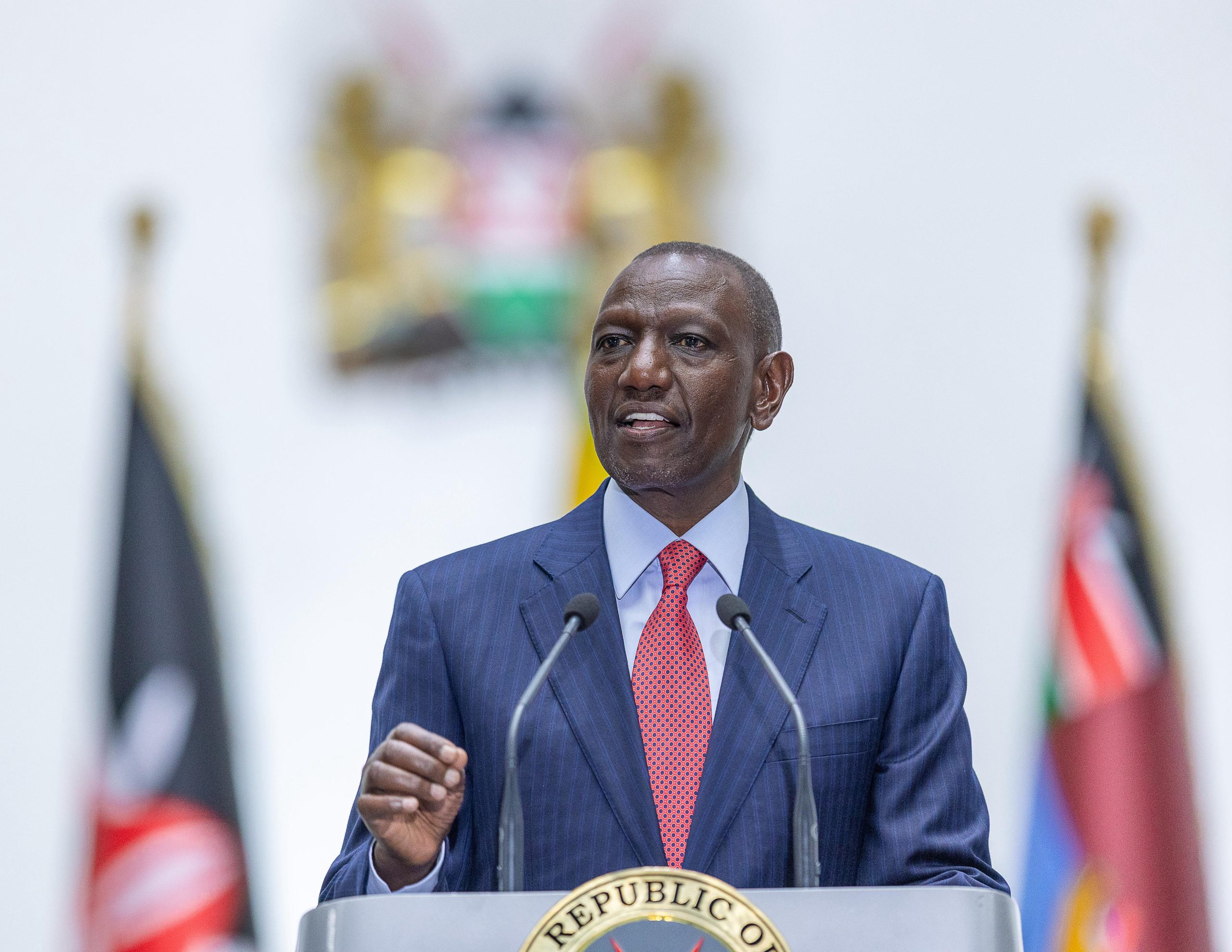
What Ruto Said
Speaking to MSME traders gathered at State House, Ruto said the government would move to protect local traders from unfair competition posed by foreign nationals engaged in small-scale hawking and trading. He said the complaints driving the decision were specific and recurring: Kenyan traders had raised concerns that foreigners had set up businesses selling everyday items such as duvets and other merchandise, putting them in direct competition with local hawkers and small-scale traders.
The president framed the issue in blunt terms, arguing that Kenya's push to attract foreign capital was never meant to invite this kind of competition at the bottom of the retail chain. He told the gathered traders that despite efforts to improve the economy, the country had not built investor confidence so that hawkers would come to Kenya. In a mix of English and Swahili, he was more pointed still, saying it could not be that someone travels from China or elsewhere just to become a hawker or open a small shop.
An Immediate Deadline
Unlike earlier rhetorical warnings on the subject, this directive came with a concrete timeline. Ruto ordered that the crackdown begin on Monday, September 7, declaring that from the following week, all foreign traders running such small businesses should close them. Multiple reports indicate administrative enforcement is expected to start the week of September 7, with Trade Cabinet Secretary Lee Kinyanjui overseeing the process once he returns from Addis Ababa. However, as of the announcement, the government had not yet published detailed regulations spelling out every affected business category or the exact enforcement procedure.
Ruto directed the Ministry of Investments, Trade and Industry, along with National Assembly leadership, to move quickly. He tasked Majority Leader Kimani Ichung'wah and Trade Cabinet Secretary Lee Kinyanjui with expediting passage of the Local Content Bill, 2025, to permanently lock foreigners out of designated informal and small-scale sectors.
The Legislative Backbone: The Local Content Bill
While the administrative order can take effect quickly, Ruto has been equally focused on giving the policy a durable legal foundation. He confirmed that a Bill currently before Parliament seeks to restrict foreign nationals from engaging in certain trading activities, and urged traders and other stakeholders to scrutinize the legislation closely to close any gaps before it passes. In his own words, relayed by local outlets, he wants people to sit down with businesses to review the bill so that no loophole is left open that would let, for instance, someone come from China to become a hawker.
The proposed Local Content Bill, 2025, goes well beyond hawking. According to reporting on its provisions, it sets an 80 percent Kenyan workforce requirement for foreign enterprises operating in Kenya, extending the local-hiring mandate all the way up to executive and C-suite roles. It would also compel companies to source locally: foreign firms would need to employ Kenyans for at least 80 percent of their workforce and source at least 60 percent of specified goods and services domestically, while manufacturers relying on agricultural inputs would be required to buy entirely from Kenyan farmers. The bill is being advanced alongside proposed amendments to the Public Procurement Act, both aimed at curbing foreign dominance in the economy and mandating local hiring.
Part of a Wider Pattern
Analysts and local media have situated the hawking crackdown within a broader turn in Ruto's economic messaging toward economic nationalism. In the same period, Ruto ordered Tata Chemicals Magadi Limited to cease operations and leave Kenya, citing over a century of resource extraction in Kajiado County without adequate benefit to local residents — a dispute that followed the mining ministry's earlier suspension of the company's operations over non-compliance with the Mining Act. At the same time, the government has taken steps aimed at easing the path for smaller domestic traders, including lowering the consolidated cargo benchmark used by importers to Sh2 million, down from Sh2.5 million.
Diplomatic Friction
The order has not been received as a purely domestic matter. Kenya's East African neighbors, whose citizens make up a significant share of cross-border small traders, are watching closely. Reporting on the policy's regional fallout notes that it lands awkwardly against recent diplomatic commitments: during talks in May 2026, Kenya and Tanzania set a target of raising new trade to Ksh130 billion and fresh cross-border investment to Ksh65 billion over three years, while pledging to dismantle non-tariff barriers hampering commerce between the two countries. At the time, Ruto himself described the removal of such barriers as essential to deepening economic ties between the two nations. The new hawking directive, by contrast, threatens to introduce a fresh point of friction into that relationship, since many of the small traders likely to be affected are Tanzanian, Ugandan, and other regional nationals working in Kenya's cities.
Why It Matters
For Ruto, the political calculation appears straightforward: hawking and small-scale retail employ enormous numbers of Kenyans in an economy where formal job creation has struggled to keep pace with a young, fast-growing population, and visible competition from foreign traders in that space has become a source of public frustration. Enforcing the crackdown administratively, ahead of any parliamentary vote, lets the president respond to that frustration immediately rather than waiting for the Local Content Bill to clear the legislative process.
But the approach carries real risks. Moving before regulations are finalized risks uneven or arbitrary enforcement on the ground, and singling out foreign traders by nationality could complicate Kenya's standing within the East African Community, where free movement of labor and trade is, at least on paper, a founding principle. Whether the September 7 enforcement date produces an orderly transition — or a messy, legally contested one — will likely shape how the policy is remembered.
This article reflects reporting as of September 3, 2026. Enforcement details and the status of the Local Content Bill, 2025, may change as Parliament and the Ministry of Investments, Trade and Industry finalize their approach.