
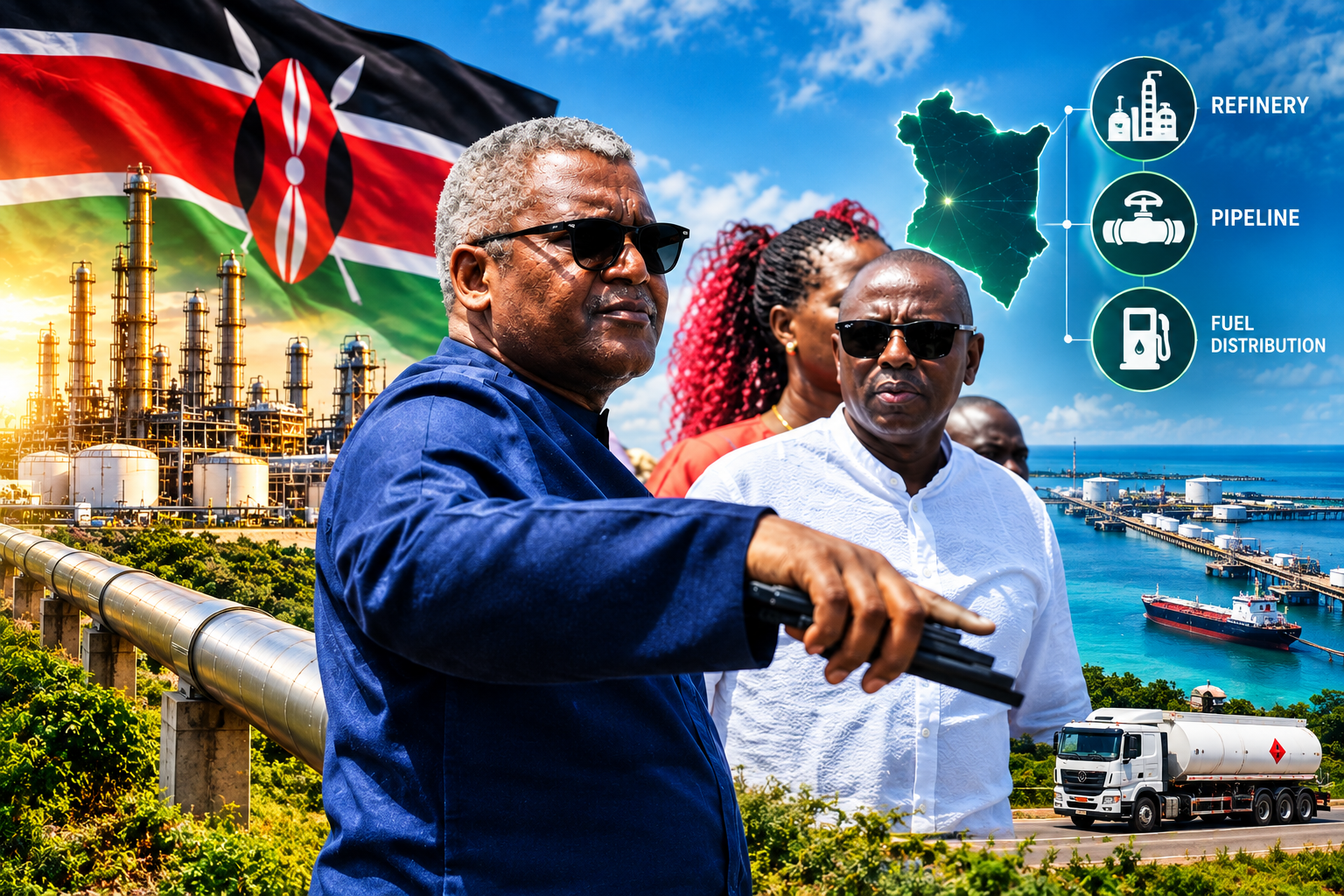
Aliko Dangote’s expanding presence in Kenya is becoming a defining test of the country’s economic ambitions, its approach to strategic infrastructure and the balance between attracting private capital and protecting public interests.
In late September 2026, Nigerian industrialist Aliko Dangote joined President William Ruto in Lamu for the groundbreaking of a proposed multibillion-dollar oil refinery. The ceremony projected a familiar message: that large-scale industrial investment could transform Kenya from a regional importer of refined petroleum products into a centre for manufacturing, energy processing and distribution.
Yet the symbolism of the event was complicated by a land dispute involving 133 residents who claim that the project threatens property and livelihood interests they have held for generations.
Weeks later, another development brought Dangote’s expanding Kenyan interests into sharper focus. The billionaire confirmed that his business interests had acquired a 24.76 per cent stake in Kenya Pipeline Company (KPC), a transaction valued at approximately Sh42.5 billion.
At the same time, Kenyan investors were being offered a route into the ownership of Dangote Petroleum Refinery and Petrochemicals in Nigeria through a cross-border initial public offering (IPO) arrangement approved by the Capital Markets Authority of Kenya (CMA).
Taken together, the developments reveal three distinct but increasingly interconnected dimensions of Dangote’s African strategy: raising capital from across the continent, investing in strategic energy infrastructure and positioning businesses to participate in the movement and supply of petroleum products.
They also raise difficult questions for Kenya. Who benefits when strategic assets change hands? What protections exist for communities affected by industrial expansion? And how should the country balance the promise of investment against the risks of concentrated economic power?
The answers will help determine whether Dangote’s expanding footprint becomes a model of African industrial integration or a case study in the challenges of managing powerful private investment.
Act I: The KPC Deal That Changed the Conversation
For several days, a major transaction on the Nairobi Securities Exchange (NSE) attracted attention without immediately revealing the identity of its ultimate buyer.
The mystery ended on October 21, when Dangote disclosed in London that his business interests had acquired approximately a quarter of Kenya Pipeline Company.
According to reports by Business Daily Africa and Reuters, the transaction involved 4.5 billion shares and was valued at Sh42.5 billion, equivalent to approximately $327 million. The 24.76 per cent holding came from shares sold by state-linked institutions following KPC’s market debut earlier in the year.
The significance of the acquisition lies not simply in its monetary value, but in the nature of the business involved.
KPC operates infrastructure central to Kenya’s petroleum supply chain, transporting fuel from the coast towards inland markets and regional destinations. Its network serves a market extending beyond Kenya’s borders, supporting petroleum distribution to neighbouring countries that depend on regional transport corridors to meet their energy needs.
Pipelines may not have the visibility of refineries, petrol stations or fuel tankers, but they occupy a critical position in the energy economy. They connect imported or locally processed petroleum products to the businesses, households, industries and transport systems that consume them.
The company’s strategic importance means that a substantial private shareholding deserves scrutiny beyond the usual questions asked of a stock-market investment.
Why 24.76 per cent matters
A holding of nearly one-quarter of a company can confer considerable influence, particularly where the shareholder becomes one of the largest investors and may qualify for representation on the board.
It does not, however, automatically confer operational control or a veto over every corporate decision. The extent of Dangote’s influence will depend on KPC’s articles of association, shareholder arrangements, board structure, applicable laws and the distribution of the remaining shares.
That distinction matters because the debate should be based on the actual rights attached to the investment rather than assumptions that ownership alone gives one investor control over the national petroleum supply chain.
Nevertheless, the strategic implications are substantial.
An investor with interests in refining and a major shareholding in pipeline infrastructure occupies positions at different stages of the petroleum value chain. Those positions can create commercial advantages, from better knowledge of distribution constraints to opportunities for coordinated investment in storage, transportation and supply.
They can also create potential conflicts of interest if the same business group competes with companies that rely on infrastructure in which it holds a significant stake.
The central question is therefore not whether a private investor should be allowed to own shares in a pipeline company. It is whether the governance and regulatory arrangements surrounding that ownership are strong enough to protect competition and the interests of other users.
Act II: Privatization, Public Money and the Accountability Question
The KPC transaction has opened a wider debate about the government’s decision to sell shares in a strategically important state-linked enterprise.
The company’s listing created an opportunity for investors to participate in its ownership and for the state to raise capital through the market. Such transactions can deepen domestic capital markets, broaden share ownership and reduce the government’s direct exposure to commercial businesses.
But privatization is not automatically beneficial simply because a transaction generates revenue.
Its long-term value depends on the price obtained, the transparency of the process, the quality of corporate governance after the sale and the safeguards that preserve the public interest.
The timing of the KPC share sales has sharpened these questions. Reports that state-linked institutions sold holdings acquired during the company’s IPO have prompted scrutiny of why public institutions bought the shares and subsequently disposed of them within a relatively short period.
Several issues warrant clear answers.
First, what were the original investment objectives of the institutions that acquired KPC shares? Were the purchases intended as long-term investments, temporary placements of public funds or part of a broader government strategy?
Second, what considerations informed the decision to sell? Public accountability requires clarity about whether the disposals reflected portfolio management, liquidity requirements, investment returns or another policy objective.
Third, how was the transaction executed? Information about the seller identities, transaction approvals, pricing, applicable restrictions and any regulatory disclosures would help the public assess whether the sale was conducted fairly and in accordance with the law.
Finally, what protections remain in place to ensure that KPC continues to operate in the interests of the wider petroleum market?
These are questions that should be addressed through documentary evidence, company disclosures and statements from the relevant institutions. The transaction alone does not establish wrongdoing, nor does the involvement of a foreign investor demonstrate that the sale was improper.
The deeper issue is whether Kenya has established a transparent framework for determining how strategic public assets are sold and how their continued public importance is protected after ownership changes.
The pipeline is not an ordinary commercial asset
KPC’s importance extends beyond its shareholders.
Reliable fuel transportation affects the cost and availability of petroleum products, the movement of goods and the operations of businesses throughout the region. Disruptions or inefficiencies can ripple through transport, agriculture, manufacturing and other fuel-dependent sectors.
That makes the company’s commercial performance a matter of broader economic interest.
The appropriate response is not necessarily to prohibit private ownership. Rather, it is to ensure that the company operates under clear rules, that access to its infrastructure is fair and that decisions affecting tariffs, capacity allocation and investment remain subject to appropriate oversight.
For competing oil marketers, the concern is whether a major shareholder with interests elsewhere in the petroleum value chain could gain an unfair advantage.
Such a risk should be assessed through competition analysis, shareholder governance and the applicable regulatory framework—not presumed to be an established outcome.
The test for Kenya will be whether it can attract capital without allowing the strategic importance of its infrastructure to become a source of market distortion.
Act III: Lamu and the Human Cost of Industrial Ambition
While the KPC transaction unfolded in financial markets, another dimension of Dangote’s Kenyan ambitions was emerging on the coast.
The proposed Dangote East African Refinery in Lamu has been presented as a major industrial investment with the potential to expand petroleum processing, create employment and strengthen Kenya’s position in regional energy trade.
The project is envisaged as a refinery with a capacity of approximately 700,000 barrels per day. Its proponents argue that a facility of this scale could reduce dependence on imported refined products, support associated industries and create opportunities across construction, logistics, maintenance and commercial services.
But the project’s ambitions have collided with a fundamental question: what happens to the people who already occupy or claim rights over the land required for development?
In September, 133 residents from Chandavai challenged the use of disputed land linked to the refinery in the Malindi Environment and Land Court. They argued that they had occupied, cultivated or developed the affected land over generations and that their interests had not been adequately recognised in the acquisition process.
According to reports by The Star and People Daily, the court issued orders concerning the disputed parcel, identified as LR No. 13061 in the Hindi/Manda Magogoni area, pending further proceedings. The reports differed in how they described the restrictions imposed, making the precise terms of the court order important to establishing which activities were affected.
The court proceedings did not, by themselves, finally determine the underlying land claims.
The dispute places land rights at the centre of a project often discussed primarily in terms of investment, capacity and employment.
For the residents involved, land is not simply a factor of production that can be transferred from one owner to another. It may support homes, farms, family livelihoods, cultural connections and long-standing patterns of settlement.
Where people claim customary interests, long-term occupation or other legally recognisable rights, the question of compensation cannot be resolved merely by pointing to a project’s national economic importance.
The relevant authorities must establish which interests are legally protected, how the acquisition process was conducted, whether affected people were properly consulted and what compensation or other remedies may be due.
These questions must be resolved through the applicable legal process. The residents’ claims should not be treated as judicially established facts, but neither should they be dismissed simply because the proposed investment is large.
Compensation is more than a payment
Land acquisition disputes often become contentious because compensation is treated as a financial transaction when the consequences extend well beyond the transfer of property.
A household that loses agricultural land may receive compensation yet struggle to replace the income generated by that land. A family displaced from a familiar settlement may face higher living costs, disrupted social networks and uncertainty over future livelihoods.
For coastal communities, changes in land use can also affect access routes, local businesses and activities linked to fishing or other natural resources.
A credible resettlement and compensation framework must therefore address more than the amount paid for a parcel. It should establish who is eligible, how claims are verified, how disputes are handled and what support is available to restore livelihoods where displacement occurs.
This is particularly important when a project is expected to generate thousands of jobs. Promised employment opportunities cannot automatically compensate for losses suffered by particular households, especially if affected residents lack the qualifications or resources required to access those jobs.
Nor should communities be forced into a false choice between development and the protection of their rights.
A project can be economically transformative and still be required to meet legal obligations. Indeed, the legitimacy of large-scale investment depends partly on whether the benefits are pursued through processes that affected people can trust.
The environmental question
The scale of a refinery also demands rigorous environmental scrutiny.
Lamu’s coastal setting makes questions concerning water use, marine ecosystems, waste management, industrial emissions and the protection of sensitive habitats especially important.
The existence of environmental risks does not, by itself, establish that the project will cause particular forms of damage. Those questions require project-specific environmental assessments, technical evidence, transparent monitoring and effective enforcement.
The National Environment Management Authority (NEMA) and other relevant agencies have an important role in ensuring that the required assessments and approvals are in place and that applicable environmental safeguards are enforced.
Authorities should make relevant assessments accessible to the public, explain the measures proposed to prevent or mitigate harm and provide credible mechanisms for receiving and investigating community complaints.
Water availability deserves particular attention in a region where competing demands from households, agriculture, industry and ecosystems may create pressure during dry periods.
The issue is not whether industrial development should take place on the coast. It is whether the project can demonstrate that its resource requirements and environmental impacts have been properly assessed and that enforceable safeguards will remain in place throughout its life.
For an investment of this scale, environmental responsibility should be built into the project’s economic case rather than treated as an obstacle to be addressed after construction begins.
Act IV: The IPO—Opening African Industry to African Investors
Dangote’s expanding interests in Kenya are not limited to physical infrastructure. His Nigerian refinery has also become a vehicle for cross-border capital raising.
In October, the Capital Markets Authority of Kenya approved arrangements allowing eligible Kenyan investors to participate in the IPO of Dangote Petroleum Refinery and Petrochemicals through global depositary receipts.
The offering, launched in Nigeria in September, sought to raise approximately $1.6 billion. According to the CMA, the Kenyan arrangement was intended to provide local investors with a route to participate in the Nigerian refinery offering through a depositary-receipt structure, subject to the relevant approvals and transaction conditions.
The distinction is essential. The IPO relates to the Nigerian refinery, not the proposed Dangote East African Refinery in Lamu.
Investing in Dangote’s established Nigerian refinery does not mean an investor owns part of the proposed Lamu project or has acquired a direct interest in KPC.
The three developments are related through Dangote’s broader business ambitions, but they are separate transactions involving different companies, assets and investment risks.
The promise of cross-border ownership
For Kenya’s capital markets, the arrangement represents an opportunity to widen the range of investments available to local investors.
Historically, retail investors have often found it easier to buy shares in domestic companies than to navigate the legal, custodial, currency and settlement requirements associated with foreign markets.
Depositary receipts can help bridge that gap by allowing investors to obtain economic exposure to a foreign company through a locally accessible market structure.
If implemented effectively, such arrangements could strengthen regional financial connections, encourage more companies to raise capital across African borders and give investors opportunities beyond their home markets.
But accessibility should not be confused with safety or guaranteed returns.
An IPO is not automatically a good investment because the company is prominent, the entrepreneur is wealthy or the underlying asset is strategically important.
Investors must consider the company’s valuation, profitability, debt, capital requirements, governance, dividend policy and exposure to changes in energy markets. They must also understand the risks associated with the depositary-receipt structure, including currency movements, liquidity, fees and the relationship between the receipts and the underlying shares.
The CMA cautioned that its approval was not a recommendation to invest and encouraged prospective investors to seek independent professional advice.
That warning deserves emphasis. Participation in a high-profile offering can create a sense of national or continental pride, but investment decisions should ultimately rest on financial analysis and the investor’s own circumstances.
African capital for African industrialisation
The broader significance of the offering lies in the possibility of mobilising African savings for African industrial projects.
Large industrial facilities require substantial long-term financing. When companies can attract capital from investors across multiple African markets, they may become less dependent on a narrow pool of lenders or investors.
That could support the development of deeper regional capital markets and strengthen the relationship between African businesses and the households whose savings help finance them.
Yet the benefits depend on credible disclosure and meaningful accountability. Wider ownership must come with sufficient information for investors to assess the company’s performance and understand their rights.
The key question is not simply how many people can buy into a major industrial company. It is whether they have the information and protections needed to make informed decisions about the risks they are taking.
Act V: The Refinery and the Battle for East Africa’s Energy Market
The proposed Lamu refinery places Dangote’s Kenyan strategy in a wider regional context.
Kenya occupies a strategically important position in East African trade. Its ports, roads, storage facilities and pipelines connect imported goods and petroleum products to inland markets and neighbouring economies.
A major refinery could alter the structure of that supply chain by adding domestic processing capacity and potentially reducing the region’s dependence on refined petroleum imported from outside Africa.
For Kenya, the potential gains extend beyond the sale of fuel.
A project of this scale could generate demand for construction services, engineering, equipment, transport, storage, maintenance and other supporting activities. If local firms and workers can participate meaningfully, some of the investment’s benefits could spread beyond the refinery itself.
However, the scale of the proposed facility also raises difficult commercial questions.
A refinery’s viability depends on access to crude oil, reliable transport, energy and water supplies, financing, operational efficiency and sustained demand for its products. It must compete with other refining centres and account for changing international prices, shipping costs and regulatory requirements.
Building a large facility does not guarantee that its output will always be cheaper than imported alternatives. Nor does increased refining capacity automatically translate into lower retail fuel prices.
Those outcomes depend on the cost of crude oil, refining margins, logistics, taxes, exchange rates, competition and the way savings are passed through the supply chain.
The refinery’s eventual contribution to Kenya’s economy will therefore depend on its commercial performance as well as its construction.
Integration: Efficiency or concentration?
When refining, storage, transportation and distribution are considered together, the potential advantages of coordination become clear.
Businesses operating across multiple stages of the petroleum chain may be able to plan supply more efficiently, reduce logistical bottlenecks and make better use of infrastructure.
Dangote’s interests in Nigeria’s refining industry, his proposed Lamu project and his KPC shareholding place him in a position to participate in several parts of this wider system.
But vertical integration can also raise competition concerns when a company has the ability or incentive to favour its own businesses over independent competitors.
The concern is particularly important where infrastructure functions as a critical gateway to the market. If competing suppliers depend on the same pipeline network, fair access and transparent operating conditions become essential.
A significant shareholding alone does not prove that preferential treatment will occur. The appropriate response is to examine the company’s governance arrangements and the rules governing access to infrastructure, tariffs, capacity allocation and related-party transactions.
Kenyan regulators should ensure that no shareholder can use its position to undermine fair competition, whether through direct conduct, discriminatory access or decisions that place competitors at a disadvantage.
That is not an argument against industrial integration. It is an argument for rules that allow efficiency gains without allowing the benefits of market power to be concentrated in ways that harm consumers or other businesses.
Act VI: The Question of Economic Sovereignty
The debate surrounding Dangote’s expanding interests ultimately touches a larger question: what does economic sovereignty mean for a country seeking foreign investment?
Economic sovereignty does not necessarily require the state to own every strategic enterprise. Governments can use private investment to expand infrastructure, deepen capital markets and bring in expertise that might otherwise be difficult to finance.
But sovereignty also involves retaining the capacity to set rules, enforce standards and protect the public interest regardless of the identity or wealth of an investor.
That capacity is tested when an investor has substantial resources, operates across several jurisdictions and holds interests in multiple parts of an essential supply chain.
The relevant question is whether institutions can apply the law consistently, require adequate disclosure, enforce competition rules and resolve disputes independently.
For Kenya, the KPC transaction raises questions about the management of public shareholdings. The Lamu dispute raises questions about land acquisition, consultation and legal remedies. The IPO raises questions about investor protection and cross-border financial regulation.
These are not identical issues, but they share a common theme: the need for strong institutions to govern large transactions in the public interest.
A country that attracts investment without maintaining credible oversight risks weakening public confidence. Conversely, a country that establishes predictable rules and enforces them fairly can make itself more attractive to serious long-term investors.
The choice is not between welcoming investment and protecting national interests. The challenge is to achieve both.
What Kenya Should Demand Next
The developments surrounding Dangote’s Kenyan investments call for a clear, evidence-based public debate rather than a contest between uncritical enthusiasm and blanket opposition.
Several priorities stand out.
First, transparency in KPC ownership and governance. The relevant institutions should ensure that the transaction, shareholder rights and any applicable regulatory approvals are properly disclosed. The public should be able to understand how the sale was conducted and what governance safeguards apply.
Second, effective competition oversight. Regulators should assess any potential conflicts arising from significant shareholdings in essential infrastructure by investors with interests elsewhere in the petroleum value chain. The aim should be to ensure fair access, not to presume misconduct.
Third, a credible resolution of the Lamu land dispute. The parties should comply with court directions while the legal claims are heard. The relevant authorities should provide transparent information about land acquisition, compensation and resettlement, and the courts should determine the disputed claims according to the evidence and applicable law.
Fourth, rigorous environmental accountability. The project should be subject to the required assessments, approvals and monitoring, with meaningful public access to information and effective enforcement of applicable safeguards.
Fifth, informed participation by retail investors. Financial intermediaries and regulators should ensure that prospective investors understand the terms, costs and risks of the Nigerian refinery investment. Cross-border access is valuable only when accompanied by adequate disclosure and investor protection.
These measures would not undermine the investment case. They would help establish the conditions under which its economic benefits could be pursued with greater public confidence.
Conclusion: A Defining Test for African Industrial Capital
Aliko Dangote’s expanding interests in Kenya represent more than a series of business transactions. They bring together the ambitions of African industrialisation, the growing integration of regional capital markets and the increasingly important role of private investors in strategic infrastructure.
The KPC acquisition places a major private investor inside a company central to petroleum transportation. The proposed Lamu refinery could add significant processing capacity to East Africa’s energy system. The Nigerian refinery IPO offers eligible Kenyan investors a route into the ownership of a major African industrial asset.
Each development carries opportunities. Each also raises questions that cannot be answered by the size of the investment alone.
For Kenya, the challenge is to ensure that strategic infrastructure remains governed by transparent rules, that competition is protected, that affected communities receive due process and that retail investors understand the risks they are accepting.
For Dangote, the long-term measure of success will be more than the number of assets acquired or the scale of the capital deployed. It will also depend on whether the businesses he builds and invests in create durable economic value while operating within credible legal and regulatory frameworks.
The land dispute in Lamu must be resolved through the courts. The questions surrounding KPC’s share sale require clear disclosures and institutional accountability. The investment opportunity offered through the Nigerian refinery IPO must be judged on its own financial merits.
None of these issues, taken alone, establishes that Dangote’s expansion will benefit or harm Kenya. Together, however, they demonstrate why the country must look beyond headline investment figures to the rules, relationships and public consequences that shape large-scale economic change.
Dangote’s entry into Kenya’s energy infrastructure may become an important chapter in the evolution of African-owned industry. Whether it ultimately strengthens regional integration and broad-based prosperity will depend not only on the investor’s ambitions, but also on the institutions that govern the markets, land and infrastructure in which those ambitions take shape.
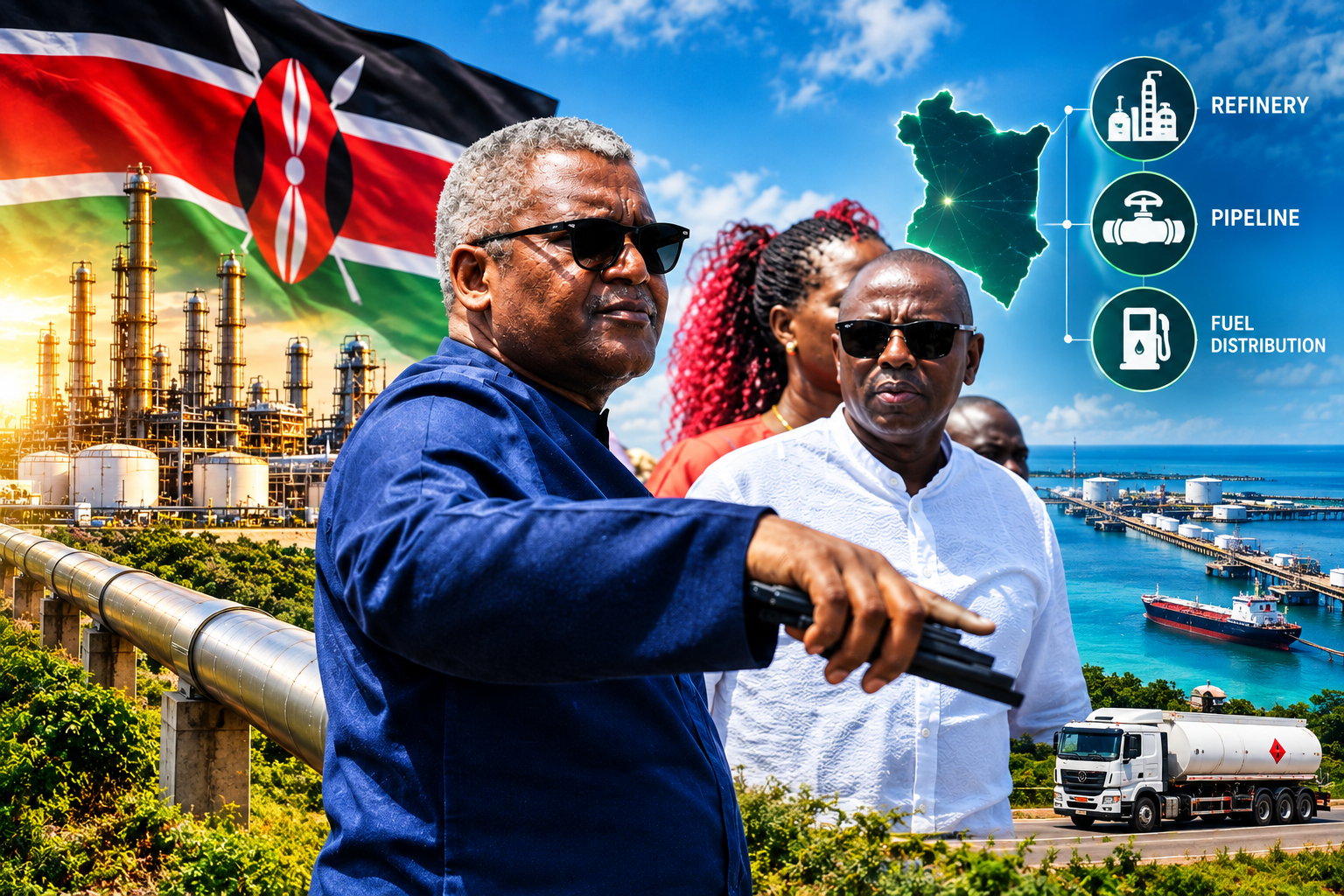
Aliko Dangote